The partnership between Suno and Warner Music Group marks a turning point in how AI music platforms operate. What began as a conflict over training data and copyright has evolved into a formal licensing relationship that will reshape Suno’s models, its business model, and the way users can distribute and monetize AI-generated music.
This analysis examines what the deal appears to mean in practice: the shift to “licensed models,” the likely use of audio watermarks and fingerprinting, changes to download rights and pricing, the introduction of opt-in artist layers, and how the triangular relationship between labels, Suno, and end users is likely to function going forward.
From Lawsuits to “Licensed AI Music Platform”
Suno, like other AI music generators, initially operated in a legal grey zone. Major labels, including Warner, accused such systems of training on large catalogues of commercial recordings without permission, often via large-scale scraping or stream-ripping of platforms hosting copyrighted music.
The new Suno–Warner partnership resolves that conflict in a formal way. Public statements and reporting indicate three central elements: Warner ends its legal action; Warner grants Suno licensed access to its catalogues (sound recordings and publishing); and Suno commits to launching a new generation of “more advanced and licensed” models in 2026 while deprecating its current models.
In other words, the dispute over how past models were trained is being closed through settlement, and the future is explicitly framed as a “licensed AI music platform” rather than one built on unconsented scraping.
What “Licensed Models” Likely Means in Practice
The phrase “trained on licensed and authorized music” can easily be misunderstood as implying that every track ever used in training has an individual license. In practice, licensing at this scale rarely works that way.
For major labels, “licensed models” usually means that key catalogues which were previously used without permission are now covered by contractual agreements. In the Suno–Warner context, this primarily involves Warner’s sound recordings and its Warner Chappell publishing catalogue, which are now explicitly authorized for model training and certain types of interactive use.
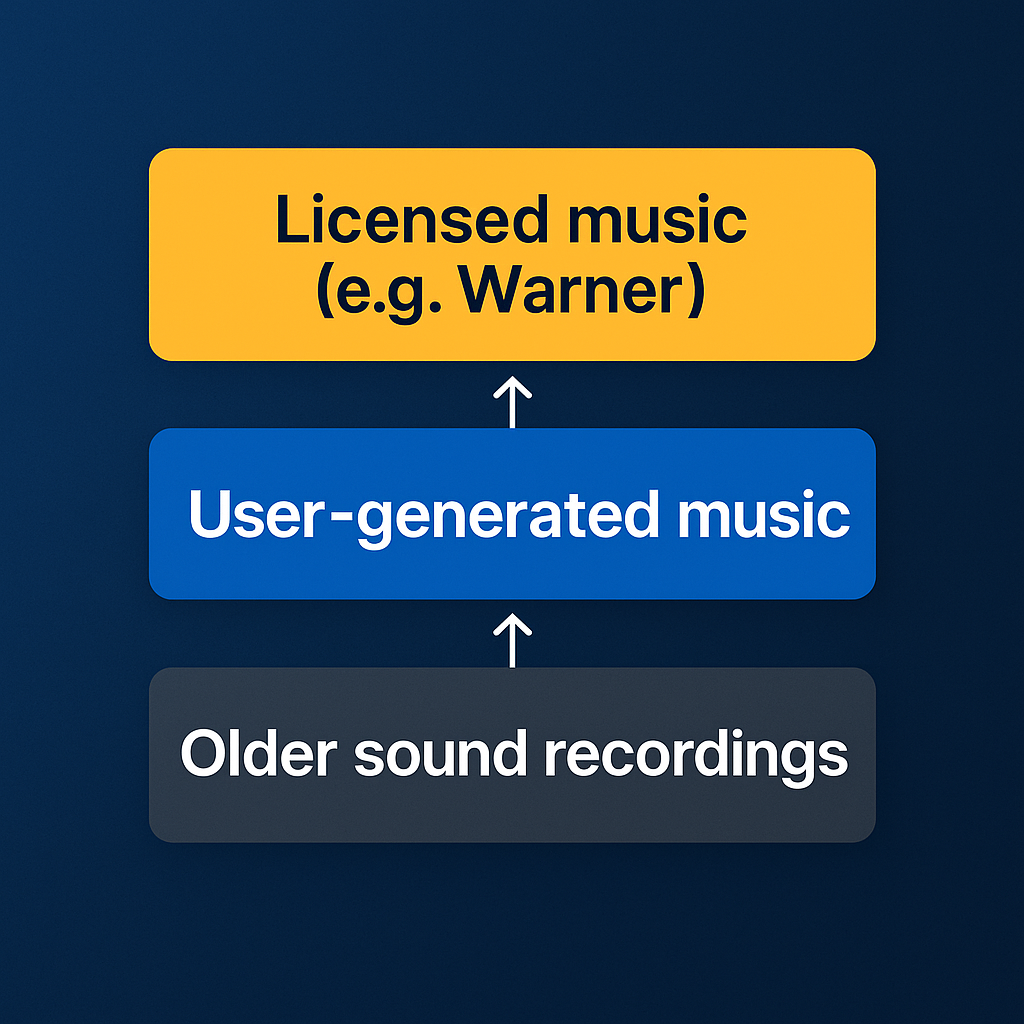
Beyond that, Suno has at least two other significant sources of training data. The first is the historical knowledge embedded in its existing models, such as v5, which already encode musical patterns learned from earlier, more loosely sourced data. The second is Suno’s own user-generated corpus. Under typical AI platform terms, both user submissions (lyrics, prompts, uploaded audio) and model outputs may be reused by the provider for model improvement and further training. That gives Suno a large, contractually controllable internal dataset: millions of tracks generated on its own platform.
The most plausible scenario is therefore a layered one. Older models provide an initial representation of musical structure and style. User-generated Suno tracks, which Suno is expressly allowed to reuse for training, form a large intermediate corpus. On top of that, licensed catalogues such as Warner’s supply high-quality studio audio and compositional material under direct license. The resulting new models can then be marketed as “licensed and authorized,” because their training pipeline is now based on sources for which Suno has explicit contractual rights, rather than raw scraping.
The important point is that “licensed” in this context is a legal and business category, not a literal claim that every historical training sample has been individually cleared retroactively. What matters to labels is that going forward the pipeline runs through authorized catalogues and controlled corpora.
Audio Watermarks and Fingerprinting: How Suno and Warner Can Track AI Music
One crucial technical piece in this new regime is the ability to identify when audio has been generated by Suno’s models. There are increasing indications that Suno already uses some form of digital audio watermark or fingerprint. Community discussions, technical observations and commentary suggest that Suno embeds an inaudible signature into its output, which can later be recognized even after transcoding or minor edits.
In parallel, recent deals between major labels and AI platforms such as Udio explicitly mention content filtering and fingerprinting as part of a “responsible” AI ecosystem. Labels want not only licensed training data, but also technical mechanisms to detect, categorize and, where necessary, monetize AI-generated material in downstream platforms.
Within this framework, an embedded watermark in Suno audio serves several purposes. It allows Suno itself to detect where its outputs are being used. It provides a basis for potential whitelisting or policy decisions by services such as YouTube or Spotify that may want to differentiate AI music from human-produced content. And, critically for the Warner deal, it creates a technical channel for associating certain AI outputs with licensed artist layers, enabling revenue-sharing and enforcement when artists opt in to having their likeness, voice or compositions used in generative experiences.
Whether Suno’s fingerprinting scheme is identical or compatible with that of another platform like Udio is unknown and likely not necessary. What matters is that each platform can reliably identify its own content and that label agreements increasingly assume such capabilities will exist.
Download Restrictions, Pricing, and the Economics of Licensing
One of the most concrete product changes announced around the Suno–Warner partnership concerns downloads. From 2026 onward, Suno has stated that downloading audio will be limited to paid accounts, that songs created on the free tier will be stream-only within the platform, and that paid plans will include monthly download caps with options to purchase additional downloads. Suno Studio, its professional tool, is expected to retain unlimited downloading.
This shift fits directly into the licensing economics. Labels have previously demanded very high per-track compensation in the context of training disputes, arguing that the use of their recordings to power generative systems has substantial value. If Suno is now paying for licensed access to catalogues such as Warner’s, it needs a sustainable revenue model tied not only to model access but also to the volume of exportable music leaving the system.
Generative activity inside the Suno interface is one level of consumption. Exportable audio files, which can be uploaded to YouTube, Spotify or other platforms and potentially monetized, are another. Charging for downloads and placing limits on the number of files that can be exported per month effectively turn those outputs into licensed products whose cost reflects both compute and upstream licensing fees.
Free users, under this model, are encouraged to experiment and share within the Suno environment but cannot freely create an unlimited library of downloadable AI songs. Paying users get finite export capacity, with additional downloads available for purchase. Suno Studio, which targets professional and semi-professional creators willing to pay for a higher-tier subscription, remains with unlimited download and more advanced workflow features, and is positioned closer to a professional tool like a DAW rather than a mass-market content toy.
In short, the rising “price” of download is a direct reflection of the cost of licensed training data and the need to align AI output with the economic expectations of rights-holders.
Artist Opt-In Layers: Voices, Likeness and Shared Revenues
A distinctive feature of the Suno–Warner collaboration is the planned introduction of artist-specific creation modes. Warner has emphasized that its artists and songwriters will have the ability to opt in to generative experiences that use their names, images, likenesses, voices and compositions.
This represents a separate “layer” on top of the general Suno model. Instead of prompting for a generic “female pop vocal,” users could be offered interactive experiences that explicitly reference a participating artist’s style or voice, under a licensing scheme negotiated with that artist and the label. In parallel deals, such as Universal’s arrangements around Udio, similar ideas are being explored: users can generate derivative works, remixes or new pieces in the style of specific artists within a tightly controlled environment, with clear attribution and participation of the artist in the economic upside.
These opt-in artist layers almost certainly will not carry the same rights profile as generic AI tracks. It is unlikely that a user would receive unrestricted commercial rights to a track explicitly branded with a major artist’s name and voice. More plausible is a model where such outputs are either confined to the platform itself or subject to defined revenue-sharing rules and distribution channels.
Audio watermarking becomes essential here. If Suno can tag these artist-linked outputs in a way that downstream platforms can detect, then revenue from streams on services such as YouTube or Spotify can, in principle, be allocated among Suno, the label and the artist according to contractual terms. Alternatively, certain artist-layered outputs may simply not be downloadable at all, mirroring restrictions observed in some Udio partnerships, and may exist only within a closed listening environment.
The precise parameters are not yet publicly specified, but structurally this implies a two-tiered system: a general “licensed model” layer and a more tightly controlled artist layer with additional constraints and revenue-sharing.
Opt-Out, Model Quality and “Clean” Generative Modes
Another open question is the extent to which users will be able to avoid artist-specific layers and work solely with a general-purpose model. It is reasonable to expect some form of separation between a broad “licensed corpus” mode and explicit artist modes.
A general-purpose mode would rely on the full licensed and authorized training data, including Suno’s internal corpus and label catalogues, but without invoking the likeness or name of any specific artist. Rights for such outputs could be closer to today’s Suno Pro/Premier model: the platform grants users a license to use and commercialize the result, while disclaiming any guarantee that the work is entirely free of third-party claims.
An artist-specific mode would expose much stronger branding and stylistic fidelity, but with narrower and more complex rights.
If opt-out from artist layers is implemented, there is a possibility that “clean” outputs may have slightly different characteristics in terms of recognizability or stylistic richness, depending on how strongly the training process relies on labeled artist data. However, advances in model architecture and distillation make it likely that the baseline quality of the general Suno model will remain high even when artist-specific contributions are conceptually separated.
What Will Likely Stay the Same and What Will Change for “Ordinary” Suno Songs
For ordinary, non-artist-specific AI tracks, the core user experience is likely to persist with important adjustments. Users will still be able to write prompts and lyrics and receive original compositions from the Suno model. The model underneath, however, will be part of a new generation trained on licensed catalogues plus the internal Suno corpus, rather than on uncontrolled scraped sources.
From a quality perspective, there is little reason to expect a collapse; in mainstream genres, quality may even improve thanks to higher fidelity training data and continued model scaling. From a rights perspective, the model will be on firmer ground in relation to the major labels through the licensing deals that underpin it.
What will change most visibly is the economics of exporting and monetizing these tracks. Downloading will become a resource governed by subscriptions and per-file costs. Files will likely carry audio watermarks that allow identification and, where relevant, tracking for policy or revenue purposes. The user’s rights to exploit the outputs commercially will remain subject both to the Suno terms and to the independent policies of distribution platforms, some of which are already introducing AI-specific rules.
The unresolved tension is that even in a licensed-model world, no AI platform can presently guarantee that a given track is entirely free from potential copyright disputes. That uncertainty remains part of the environment users must navigate.
From Unregulated Experiment to Structured AI Music Infrastructure
The Suno–Warner partnership is part of a broader industry shift. Rather than attempting to shut down AI music outright, major labels are moving toward a model where generative systems are brought into the licensing ecosystem: training data is authorized, artist participation is opt-in and compensated, technical fingerprinting makes AI outputs visible, and exportable files become economically controlled units.
For Suno, this means moving from an era of maximal freedom and legal ambiguity to one of structured constraints and formal obligations. Models will be explicitly licensed, downloads will be metered and monetized, artist-linked modes will be tightly integrated with rights management, and watermarks will be central to tracking and enforcement.
For users, the change is ambivalent. On one hand, the risk that the underlying platform will be crippled by litigation decreases, and access to licensed repertoires and official artist experiences expands the creative palette. On the other hand, the days of unlimited free downloads and largely unexamined commercial use of AI music are ending.
Suno’s future now lies in balancing these forces: preserving enough creative flexibility and economic opportunity for its user base, while adhering to the requirements of labels that increasingly see licensed AI music not as an existential threat, but as a new product line that must be accounted for, tracked and monetized.