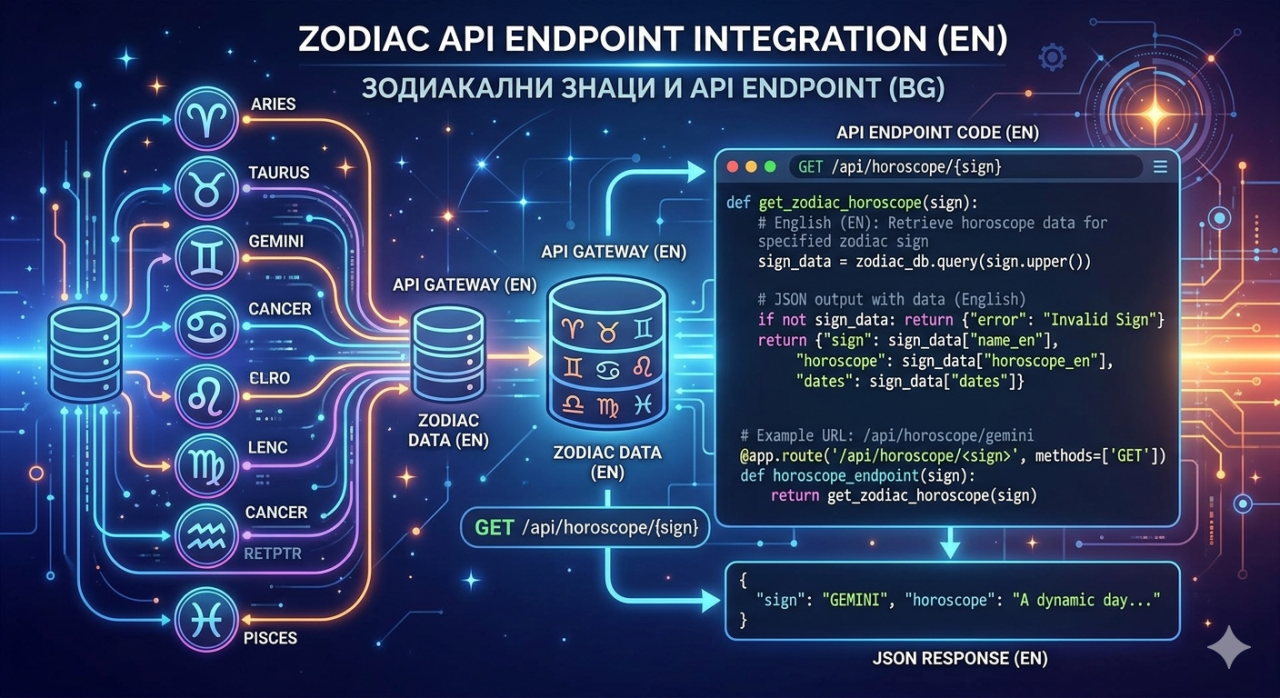
I Built a Horoscope API as an Experiment and It Became One of My Most Requested Endpoints
The decision to build a horoscope API was driven by data, not by personal conviction about celestial influence on human affairs. Keyword research tools showed remarkable search volumes for terms like "horoscope API," "zodiac API," and "daily horoscope data." The numbers were not modest. Thousands of monthly searches from developers and product teams looking for exactly this type of service, with relatively few high quality options available. The market signal was clear: people who build apps want horoscope data, and the existing supply was a collection of static, recycled content feeds that served the same generic paragraphs to every user day after day. The experiment was simple: build something better and see if the demand materialized into actual usage.
The experiment exceeded expectations almost immediately. Within weeks of launching the first batch of endpoints, API key requests started arriving at a pace that rivaled the platform's more established tools. App developers building wellness and lifestyle applications needed daily horoscope content for their users. Content platforms wanted zodiac readings to drive engagement and return visits. Entertainment apps needed compatibility calculations and tarot readings as social features that users could share with friends. Meditation and mindfulness apps wanted moon phase reports and biorhythm calculations to tie their content to celestial cycles. The diversity of use cases was broader than anticipated, and the demand was both genuine and sustained.
What started as a handful of horoscope endpoints grew into a suite of 32 endpoints spanning three interconnected domains: 20 horoscope endpoints covering zodiac profiles, daily and weekly and monthly readings, compatibility, tarot, Chinese zodiac, and numerology; 12 astrology endpoints covering natal charts, planetary positions, transits, synastry, moon phases, and lunar calendars. The astrology platform became a comprehensive mystical content API that serves the growing ecosystem of apps catering to the spiritual and astrological interests of a surprisingly large and engaged user base.
The Market That Nobody Takes Seriously but Everyone Uses
Horoscopes and astrology occupy a peculiar position in the technology industry. Most developers and technologists do not personally believe in astrological influence, and building tools for the astrology market carries a faint whiff of intellectual embarrassment that building, say, a weather API does not. But the numbers tell a story that has nothing to do with personal belief. Horoscope apps consistently rank among the most downloaded categories in app stores. Astrology content drives higher engagement rates than news, sports, or finance content on many social media platforms. The Co-Star app alone reached millions of downloads and a billion dollar valuation by serving natal chart interpretations through a mobile interface. The market is enormous, profitable, and growing, regardless of anyone's personal opinion about whether Mercury retrograde actually affects email deliverability.
The developer demand for a horoscope API reflects this market reality. Building an astrology app requires content, and content in this domain is uniquely difficult to create in house. A developer who builds a fitness app can calculate BMI using a well known formula. A developer who builds a horoscope app needs prose: evocative, varied, personalized text that reads as thoughtful and specific rather than generic and recycled. Writing this content manually is impractical at scale because users expect fresh daily readings that feel unique to their sign and circumstances. The alternative is an API that generates this content on demand, which is exactly what the horoscope API provides.
The API's differentiator in this market is freshness. Most existing horoscope data feeds serve cached content that was written once and recycled indefinitely. The same daily horoscope for Aries appears on dozens of websites and apps that all pull from the same feed, and regular users eventually notice the repetition. The horoscope API generates every reading fresh through AI, using the current date, the zodiac sign's characteristics, planetary position data, and optional personalization from the user's birth data as inputs to produce a reading that has never existed before and will never be repeated. This freshness translates directly to user retention for the apps that integrate it, because users come back daily knowing they will receive a genuinely new reading rather than a recycled one.
From Twenty Horoscope Endpoints to Thirty Two Across Three Domains
The initial launch covered the basics: zodiac profiles for each sign, daily horoscope readings, weekly and monthly forecasts, and zodiac compatibility calculations. These core endpoints addressed the most common use cases and generated the initial traction that validated the experiment. But user feedback and API usage patterns quickly revealed demand for adjacent capabilities that the initial launch did not cover. Tarot readings were requested repeatedly because apps that offer horoscopes almost always want to offer tarot as well, and the content generation approach that worked for horoscopes adapted naturally to tarot card interpretation.
Chinese zodiac calculations and forecasts filled a gap for apps serving Asian markets or multicultural audiences. Numerology endpoints emerged from the observation that numerology and astrology share a user base: people interested in one are frequently interested in the other, and app developers wanted both available from a single API rather than integrating separate services. The numerology suite grew to include life path number, expression number, soul urge number, birthday number, personal year, personal month, personal day, maturity number, personality number, and karmic debt calculations, covering the full spectrum of numerological analysis through ten dedicated endpoints.
The astrology endpoints represented a deeper technical challenge. While horoscope readings are fundamentally content generation tasks, astrology endpoints like natal charts and planetary positions require actual astronomical calculations. Planet positions at the moment of birth must be computed using orbital mechanics. House placements depend on the birth time and geographic location. Aspects between planets require angular distance calculations with specific orbs of influence. The platform handles all of this through pure PHP astronomical calculations using simplified Keplerian orbital elements, producing natal chart data that feeds into AI interpretation without relying on any external astrology library. The technical achievement of implementing orbital mechanics in a web application framework was unexpectedly satisfying for a project that started as a market experiment.
Who Actually Builds With a Horoscope API
The API's user base breaks down into several distinct categories, each with different integration patterns and content needs. The largest category by volume is lifestyle and wellness apps that include horoscopes as one feature among many. These apps might offer meditation, journaling, habit tracking, and horoscope readings as a holistic wellness experience. For these integrators, the daily horoscope endpoint is the primary touchpoint, providing a fresh daily reading that gives users a reason to open the app every morning. The horoscope becomes the engagement hook that draws users into the broader app experience.
Dedicated astrology apps represent a smaller but more intensive user category. These apps build their entire product around astrological content and use a wide range of endpoints: natal charts for user profiles, daily and weekly transits for ongoing content, compatibility for social features, and tarot readings for additional engagement. These integrators are the most demanding in terms of content quality and variety because their users are astrology enthusiasts who will notice if the readings feel generic or repetitive. The AI generated, never cached approach is particularly valuable for this segment because their users compare readings across apps and appreciate the uniqueness.
Content platforms and publishers use the API to generate horoscope sections without employing dedicated content writers. A news app that wants a daily horoscope column, a women's magazine that publishes weekly zodiac forecasts, a social media platform that offers zodiac content as shareable cards: all of these use cases involve generating astrological content at scale for audiences that consume it alongside non astrological content. The API provides the content pipeline that makes these features viable without the ongoing editorial overhead that manual content creation would require.
The Surprise of Sustained Demand
The experiment label that the horoscope API launched under assumed that demand would be temporary, seasonal, or trend dependent. The assumption was wrong. Unlike features that spike during a viral moment and then fade, the demand for horoscope API access has been steady and growing month over month since launch. This sustained growth reflects the underlying stability of the astrology market itself, which is not a trend but an enduring interest that has persisted across cultures for thousands of years. The digital expression of this interest through apps and platforms is growing because smartphone penetration and app usage are growing, but the interest itself is ancient and durable.
The growth has also been driven by expansion into new app categories that were not anticipated in the original market analysis. Dating apps have integrated compatibility endpoints to offer zodiac matching as a differentiating feature. Productivity apps have added moon phase and biorhythm data as alternative frameworks for scheduling and planning. Corporate wellness programs have included horoscope content as a lighthearted engagement feature alongside more traditional wellness resources. Each new category of integrator brings its own audience and its own usage patterns, broadening the API's user base in directions that the original experiment never considered.
The lesson of the horoscope API experiment is that market data should be trusted even when it contradicts personal intuition. The search volume data said there was demand. The competitive landscape said the existing supply was mediocre. The technology to serve the demand better was available. The only barrier was the cultural skepticism that surrounds astrology in technical circles, and that skepticism turned out to be irrelevant to the business outcome. The API serves developers who serve users who want this content, and the numbers validate the decision at every level of the chain.
Frequently Asked Questions
Do you have to believe in astrology to use the API
No. The API is a content and calculation tool used by developers building applications for audiences that engage with astrological content. Personal belief in astrological influence is irrelevant to the technical integration and the business value the API provides to app developers.
How many endpoints does the API have
The platform offers 32 endpoints across three domains: 20 horoscope endpoints (zodiac, daily/weekly/monthly readings, compatibility, tarot, Chinese zodiac, numerology), and 12 astrology endpoints (natal charts, planetary positions, transits, synastry, moon phases, lunar calendar).
Are horoscope readings cached or generated fresh
Every reading is generated fresh by AI for each request. There is no caching of content, which means two requests for the same sign on the same day will produce different readings. This freshness prevents the repetition problem that plagues cached horoscope feeds.
Can the API generate readings in languages other than English
Yes. The API supports multi language generation through a language parameter on all AI powered endpoints. Readings are generated natively in the target language rather than translated from English, which produces more natural and culturally appropriate content.
What is the difference between the horoscope and astrology endpoints
Horoscope endpoints focus on content generation: readings, forecasts, compatibility, and interpretive text. Astrology endpoints focus on astronomical calculations: planetary positions, natal charts, aspects, and transit data. Some astrology endpoints combine calculations with AI interpretation, while others return pure data.
How are credits charged for these endpoints
Credit costs vary by endpoint complexity. Data only endpoints like planetary positions and moon phases cost 0.005 credits. Standard AI readings cost 0.02 to 0.03 credits. Personalized readings that use birth data for enhanced prompts cost 0.05 credits. The higher cost for personalized readings reflects the additional AI processing required to incorporate birth chart data.