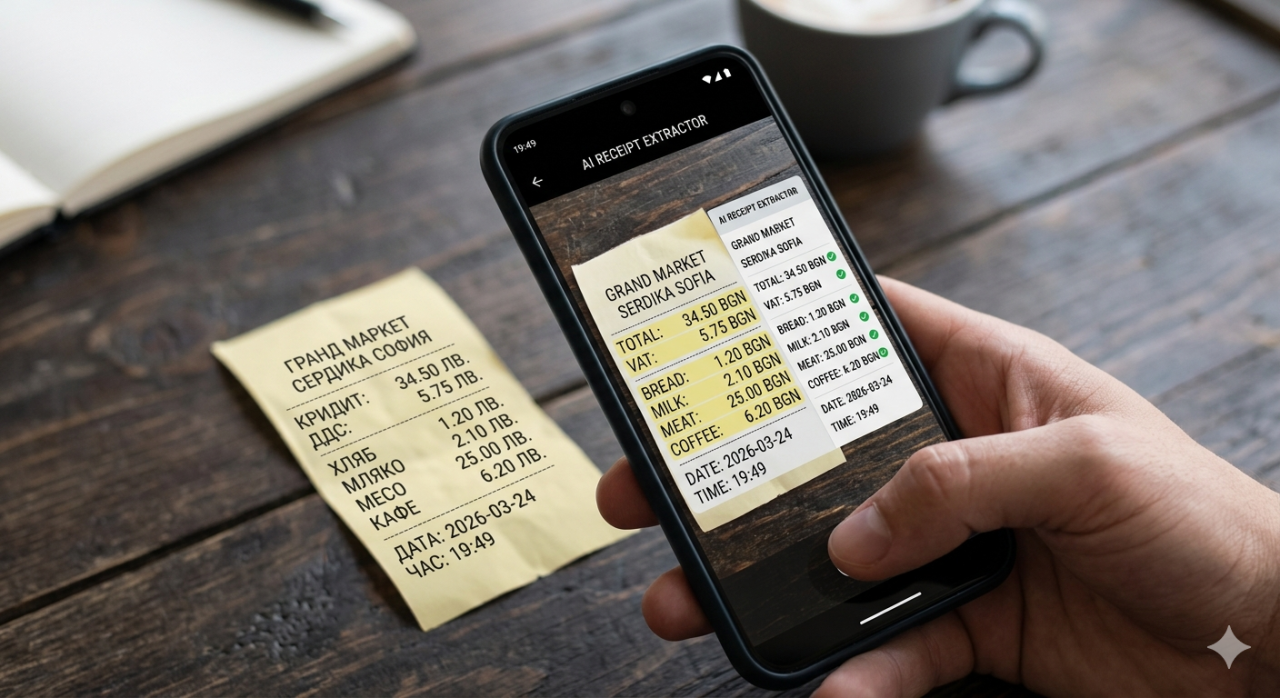
Invoices Prescriptions Business Cards and Bank Statements and One Scanner for Everything
The modern professional juggles at least half a dozen document types on any given week. An invoice arrives from a supplier and needs to be logged in the accounting system. A prescription is picked up from the pharmacy and should probably be recorded somewhere more reliable than a kitchen drawer. A business card is exchanged at a conference and the contact details need to make it into the phone before the card gets lost in a laptop bag. A bank statement arrives and the transactions need reconciling. A receipt from a business lunch needs to be attached to an expense report. A lab result from an annual checkup should be compared to last year's numbers. Each of these documents exists in a different format with different fields and different purposes, and until recently, each one required its own workflow to digitize.
The app landscape reflects this fragmentation. There are dedicated receipt scanners, dedicated business card scanners, dedicated invoice processing tools, dedicated medical document readers. Each one does its specific job reasonably well but creates its own data silo, its own account to maintain, its own interface to learn, and its own subscription to pay. The cognitive overhead of maintaining six specialized scanning apps for six document types is significant enough that most people default to the path of least resistance: take a photo with the phone camera, drop it in a folder, and hope that "photo of document in a folder" is a sufficient organizational system. It never is, but the alternative of using multiple specialized tools feels worse.
The scanner at scan.yeb.to takes a fundamentally different approach. One endpoint handles eight document types. Upload a photo of any supported document, and the AI identifies what kind of document it is, applies the appropriate extraction logic for that type, and returns structured data formatted specifically for the content that document contains. An invoice comes back with vendor name, invoice number, line items, tax amounts, and total due. A business card comes back with name, title, company, phone numbers, email, and website. A prescription comes back with medication names, dosages, frequencies, and prescribing doctor. The extraction is specialized to each document type, but the workflow is universal: photograph, upload, receive data.
What Each Document Type Produces and Why Specialized Extraction Matters
A generic OCR scanner treats every document the same way: it reads the text on the page and returns a block of text. The output of scanning a business card through generic OCR is a string of words and numbers that might look something like "John Smith Marketing Director Acme Corp 555-0123 [email protected]" with no indication of which part is the name, which is the title, which is the phone number, and which is the email. The user has to parse that output manually and place each piece of information into the correct field of their contact manager. This is marginally better than typing the card by hand, but only marginally.
Specialized extraction changes the equation entirely. The AI does not just read the text on a business card; it understands that a business card contains specific types of information arranged in predictable patterns. Names appear near the top. Titles appear below names. Phone numbers follow recognizable digit patterns. Email addresses contain the @ symbol. Websites start with recognizable prefixes. By understanding the semantics of a business card rather than just the characters, the extraction produces properly labeled, properly separated fields that can flow directly into a contact database without any manual parsing. The same principle applies to every document type the scanner handles, each one with its own semantic model and its own extraction logic.
Invoices are arguably the most complex document type because they combine narrative elements (company names, addresses, payment terms, notes) with tabular elements (line items with descriptions, quantities, rates, and amounts) and calculated elements (subtotals, tax rates, discounts, totals). The extraction needs to handle all three simultaneously, parsing the vendor information from the header, the individual charges from the item table, and the financial summary from the footer. Different companies format their invoices differently, from minimalist single-column layouts to elaborate multi-section documents with logos, terms and conditions, and multiple tax rate breakdowns. The AI handles this variation by understanding what an invoice is rather than what a specific invoice template looks like, which means it works with invoices from any vendor without requiring pre-configured templates.
Prescriptions present a different challenge entirely. Medical prescriptions use specialized notation that carries life-affecting significance. "500mg BID x 14d" means 500 milligrams twice daily for fourteen days, and misreading any part of that notation has consequences far more serious than misreading a line item on an invoice. The scanner's prescription extraction is designed with this sensitivity in mind, parsing not just the medication name and dosage but also the frequency, duration, prescribing physician, and any special instructions. The structured output makes it straightforward to maintain a personal medication history that includes not just what was prescribed but when, by whom, and at what dosage, which is precisely the kind of information that is valuable during future medical consultations but almost never tracked systematically by patients.
Bank Statements and the Financial Document Pipeline
Bank statements sit at the intersection of financial tracking and document scanning because they contain exactly the kind of structured, repetitive data that is most tedious to enter manually and most valuable once digitized. A monthly bank statement might contain fifty, a hundred, or several hundred individual transactions, each with a date, description, and amount. Typing these into a spreadsheet or accounting system is an exercise in endurance that most people avoid entirely, which means the detailed transaction-level data in bank statements goes unused by the vast majority of people who receive them. The statement gets glanced at, the total balance is noted, and the paper goes into a file where it will never be looked at again.
Scanning a bank statement through scan.yeb.to extracts every transaction as a structured record. Each record contains the date, the description (which typically includes the merchant name or transaction type), and the amount. The opening and closing balances are captured, as are any summary sections that break down the month's activity by category. This structured output can be fed into accounting software, compared against records in receipts.yeb.to for receipt matching, or simply used as the basis for a personal spending review that would be impractical to conduct from the printed statement alone.
The combination of receipt scanning and bank statement scanning creates a particularly powerful financial workflow. Receipts provide the detail: what was purchased, item by item, at each merchant. Bank statements provide the completeness: every transaction, including those that did not produce a paper receipt. Together, they give a comprehensive view of spending that neither one provides alone. The receipt shows that the 47 euro charge at the grocery store was composed of specific items at specific prices. The bank statement shows that the 47 euro charge happened on Tuesday at 3:14 PM and that there was also a 12 euro charge at a cafe the same afternoon that did not produce a receipt worth scanning. Both layers of information are useful, and the unified scanner makes both available through the same workflow.
The Eight Types in Practice and Choosing When to Scan
The eight document types the scanner supports are receipts, invoices, prescriptions, business cards, bank statements, lab results, identity documents, and general documents. Each one has its own extraction model, but the usage pattern across all of them follows the same curve of adoption. People start by scanning the document type that addresses their most immediate need. For a freelancer, that is usually invoices. For someone managing their health, it is lab results and prescriptions. For a conference attendee, it is business cards. Once the scanning habit forms around one document type, it naturally extends to others because the workflow is identical and the barrier to adding another type is zero.
The question of when to scan is essentially the question of when structured data is more valuable than a photo. For a receipt from a business lunch that needs to go on an expense report, the answer is always: scanning saves more time than it costs. For a random grocery receipt with no tax or tracking implications, the answer depends on whether expense tracking is part of the daily routine. For a bank statement, the answer depends on whether the transaction data serves a purpose beyond what the bank's online portal already provides. The scanner does not prescribe a workflow; it enables whatever workflow the user needs, from comprehensive scan-everything documentation to targeted scanning of only the documents that serve an immediate purpose.
The general document type serves as a catch-all for documents that do not fit neatly into the other seven categories. Contracts, letters, forms, notices, certificates, permits, and any other paper document that contains text worth digitizing can be processed through the general extraction pipeline. The output for general documents is the full text content with structural formatting preserved, which makes it useful for archival, search, and reference purposes even without the specialized field extraction that the dedicated document types provide. This means the scanner never refuses a document because it does not match a known type. Everything is scannable, and everything produces useful output, with the specialized types producing especially useful structured output tailored to their content.
Frequently Asked Questions
How many document types does the scanner support
The scanner at scan.yeb.to supports eight document types: receipts, invoices, prescriptions, business cards, bank statements, lab results, identity documents, and general documents. Each type has specialized extraction logic that produces structured data formatted for that document category. A general document type handles anything that does not fit the specialized categories.
Does the scanner automatically detect the document type
The AI analyzes the uploaded image and identifies the document type based on its content and structure. An invoice with line items and totals is recognized as an invoice. A business card with contact details is recognized as a business card. This automatic detection means the user does not need to specify the document type before uploading, though selecting the type manually is also an option when precision is preferred.
Can scanned invoices be exported to accounting software
The scanner produces structured data including vendor name, invoice number, date, line items with descriptions and amounts, tax calculations, and total due. This structured output can be exported in formats compatible with standard accounting software. For users of receipts.yeb.to, the invoice data integrates directly into the expense tracking system with automatic vendor matching and categorization.
What information is extracted from business cards
Business card extraction produces individual fields for name, job title, company name, phone numbers (mobile, office, fax), email address, website, and physical address. Each field is labeled and separated, ready to be imported into a contact management system without manual parsing. The extraction handles various card layouts, orientations, and design styles.
Is the scanner useful for prescription tracking
Yes. Prescription scanning extracts medication names, dosages, frequencies, durations, prescribing physician name, and special instructions. This creates a structured medication history that is valuable during medical consultations, for insurance purposes, and for personal health tracking. Having a digital record of all prescribed medications with dates and dosages provides context that paper prescriptions in a drawer cannot.
Can bank statements with hundreds of transactions be scanned accurately
The scanner handles bank statements with large numbers of transactions by processing the document systematically, extracting each transaction as a separate record with date, description, and amount. Opening and closing balances are captured alongside the individual transactions. Accuracy remains high regardless of transaction count, and the structured output makes it practical to work with statement data that would be impractical to type manually.